This vivo dual monitor stand review looks at a freestanding mount built for two ultrawide screens arranged one above the other.
Its broad padded base and adjustable brackets suit desks where a clamp mount is inconvenient, provided both monitors fit its size, weight, and VESA limits.
VIVO Dual Stand Review Summary
The quick verdict
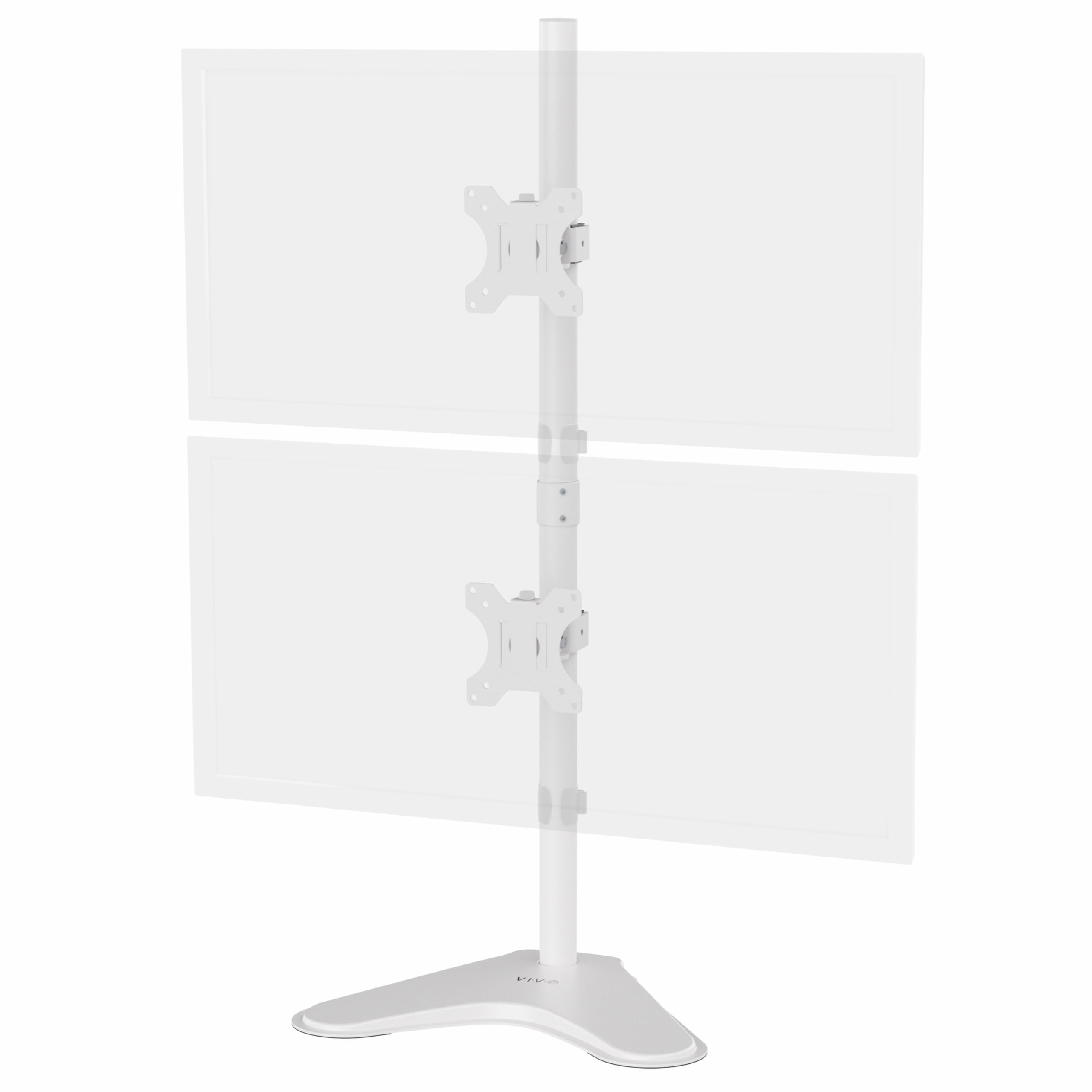
3,000+ ratings
Read Amazon ReviewsVIVO Dual Monitor Desk Stand
A good fit for buyers who want two VESA-compatible ultrawide monitors stacked vertically without clamping a mount to the desk.
- Holds two monitors, each 13 to 34 inches and up to 22 pounds.
- Fits monitors with 75-by-75 mm or 100-by-100 mm VESA mounting holes.
- Freestanding base measures 15.4 by 12.4 inches and has padding underneath to help protect the desk surface.
- Adjustable brackets provide +45° to -45° tilt, 180° swivel, and 360° rotation.

Pros
- Supports a pair of ultrawide monitors up to 34 inches, with a stated capacity of 22 pounds per screen.
- Freestanding installation can suit desks where a clamp-on mount is not preferred.
Consider before buying
- The base occupies a 15.4-by-12.4-inch area, which may compete with other desk items.
- The vertical arrangement uses screen height rather than placing both displays side by side; confirm that the upper screen will be comfortable to view from your normal position.
Read the full review summary
The VIVO Dual Monitor Desk Stand combines a central pole, two articulating brackets, and a padded 15.4-by-12.4-inch base.
It supports two monitors from 13 to 34 inches, up to 22 pounds each, with 75-by-75 mm or 100-by-100 mm VESA mounting holes.
Height adjustment along the pole and independent screen positioning give buyers room to tune a stacked arrangement.
This design is most relevant to people who want two screens in a vertical layout and prefer a base that rests on the desk.
Tilt, swivel, and full rotation allow changes to viewing angle and portrait or landscape orientation.
The tradeoff is the footprint: the base occupies desk space, so measure the available area and consider how a stacked setup fits your viewing habits before choosing it.
The buying factors
VIVO Dual Stand Scorecard
Editorial scores reflect listed features and buyer fit; they are not laboratory measurements or customer ratings.
Dual ultrawide support
Supports two screens up to 34 inches and 22 pounds each, with standard VESA hole patterns; buyers still need to check each monitor’s fit.
Positioning flexibility
Brackets tilt, swivel, and rotate, while height adjusts along the central pole.
Freestanding installation
The base avoids desk-edge clamping, which can help when a clamp mount is impractical.
Desk footprint
A 15.4-by-12.4-inch base provides a defined support area but takes up a substantial patch of desktop.
Cable organization
Integrated cable management is included to help route monitor cords.
Setup convenience
Removable VESA plates and included hardware and instructions are intended to make assembly more manageable.
Key Features and Specifications of VIVO Dual Stand
- Holds two monitors, each 13 to 34 inches and up to 22 pounds.
- Fits monitors with 75-by-75 mm or 100-by-100 mm VESA mounting holes.
- Freestanding base measures 15.4 by 12.4 inches and has padding underneath to help protect the desk surface.
- Adjustable brackets provide +45° to -45° tilt, 180° swivel, and 360° rotation.
- Screens can be positioned in portrait or landscape orientation, with height adjustment along the center pole.
- Integrated cable management helps organize cords; removable VESA plates, assembly hardware, and instructions are included.
- The product carries a three-year warranty.
Pros and Cons of VIVO Dual Stand
Pros
- Supports a pair of ultrawide monitors up to 34 inches, with a stated capacity of 22 pounds per screen.
- Freestanding installation can suit desks where a clamp-on mount is not preferred.
- Tilt, swivel, rotation, and pole-height adjustment allow a range of stacked-screen positions.
- The padded base is designed to protect the desktop from scratches.
- Removable VESA plates simplify attaching monitors before placing them on the stand.
Consider before buying
- The base occupies a 15.4-by-12.4-inch area, which may compete with other desk items.
- The vertical arrangement uses screen height rather than placing both displays side by side; confirm that the upper screen will be comfortable to view from your normal position.
- Compatibility depends on each monitor meeting the screen-size, weight, and VESA requirements, so check the monitor specifications before purchase.
Who Should Buy VIVO Dual Stand?
Good fit
Consider this stand if you want two monitors stacked vertically and need a desktop base instead of a desk-edge clamp.
Its support range covers many ultrawide setups, while the adjustable brackets provide room to angle each display and switch between portrait and landscape orientation.
It may also suit a workspace where keeping cords organized and protecting the desk surface matter. Measure the base area against the space available, then check each monitor’s weight, diagonal size, and VESA hole spacing.
Think through the upper screen’s placement as well, since a stacked layout changes where your eyes travel between displays.
The removable VESA plates and included assembly hardware are practical touches for installation. The three-year warranty adds a defined coverage period, though the most important buying check remains whether your two monitors match the mount’s limits.
Who should skip it
Look elsewhere if you specifically need two screens side by side, since this stand is designed for a vertical stack.
Skip it if either monitor exceeds 34 inches or 22 pounds, lacks the supported VESA pattern, or if the base would take too much of your usable desktop.
VIVO Dual Stand Review: Fit, Layout, and Desk Use
Check the monitor fit first
The stated compatibility combines three conditions: screen size from 13 to 34 inches, weight no higher than 22 pounds per monitor, and 75-by-75 mm or 100-by-100 mm VESA holes.
Confirm all three for each screen before buying; a monitor that meets only the size limit may still be incompatible.
A stacked layout changes the viewing rhythm
Vertical stacking can make sense when two displays need to share a compact width, but it places one screen above the other.
The adjustable brackets provide tilt, swivel, and rotation to help orient each display, and the pole allows height adjustment. Consider how often you use the upper display and whether its position will work from your regular seat.
Account for the freestanding base
The base measures 15.4 by 12.4 inches and rests directly on the desk, with padding underneath. That avoids relying on a desk-edge clamp, while making desktop clearance a key part of the decision.
Measure the area and make sure the stand can sit where the screens can be positioned as intended.
Useful adjustment with a fixed support point
The brackets offer a broad set of angle changes, and the screens can rotate between portrait and landscape. This gives flexibility for different content and viewing preferences, while the freestanding base remains the support point.
Cable management and removable VESA plates round out a practical installation-focused feature set.
Alternatives to VIVO Dual Stand
Computer Monitor Arms alternative
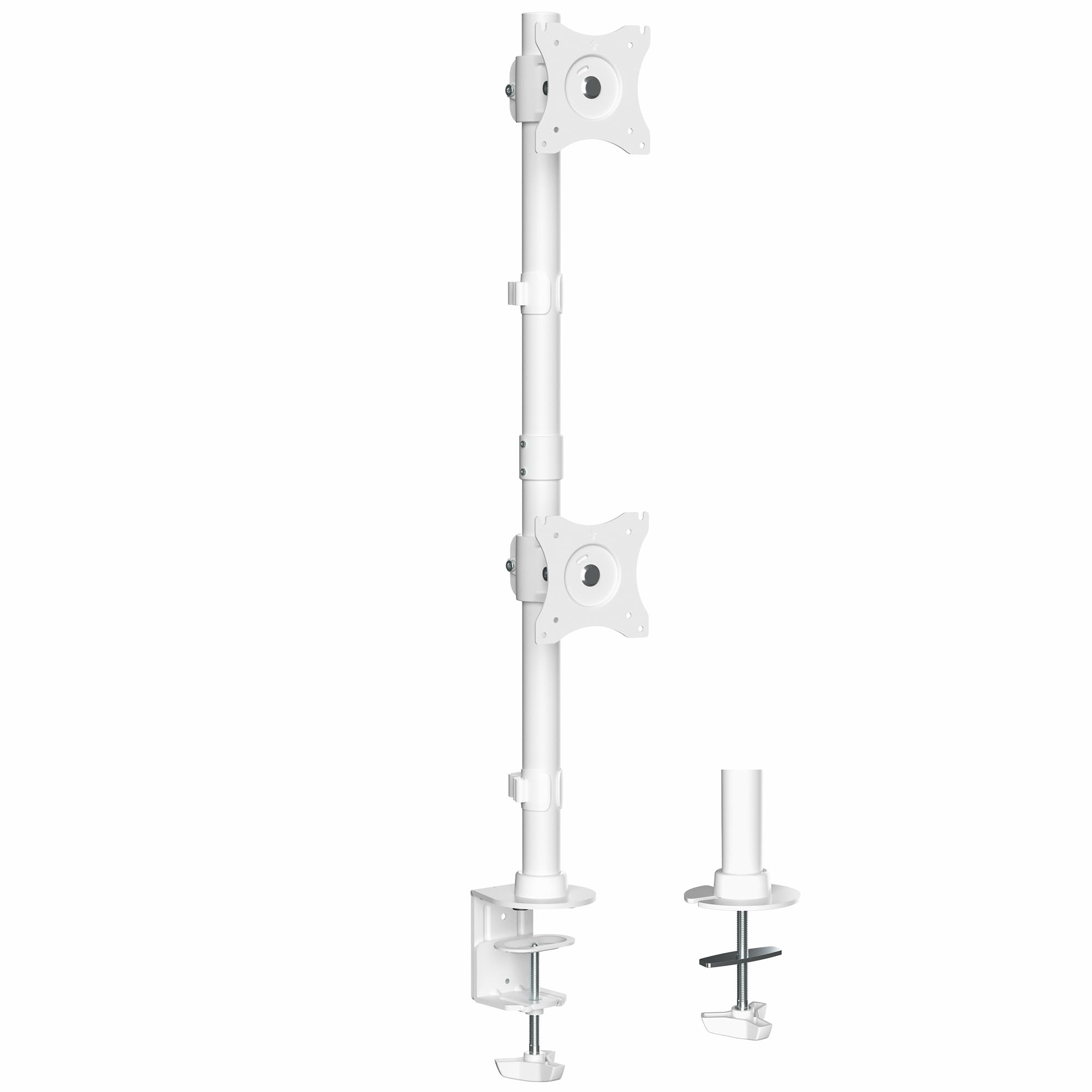
2,000+ ratings
Read Amazon ReviewsVIVO Dual Monitor Desk Mount Stand, STAND-V002RW
Choose the reviewed freestanding stand if you want a base resting on the desktop. Consider this clamp-and-grommet model if you prefer to secure the mount to the desk and its installation options suit your surface.
- This VIVO model also supports two 13-to-34-inch screens up to 22 pounds each in a vertical stack.
- It uses a desk clamp for surfaces up to 3.25 inches thick or an optional grommet mount, and its brackets offer tilt, swivel, rotation, and height adjustment along the pole.
- The VIVO Dual Monitor Desk Stand reviewed here supports two screens up to 34 inches and 22 pounds each in a freestanding vertical stack, with a 15.4-by-12.4-inch base.
Computer Monitor Arms alternative
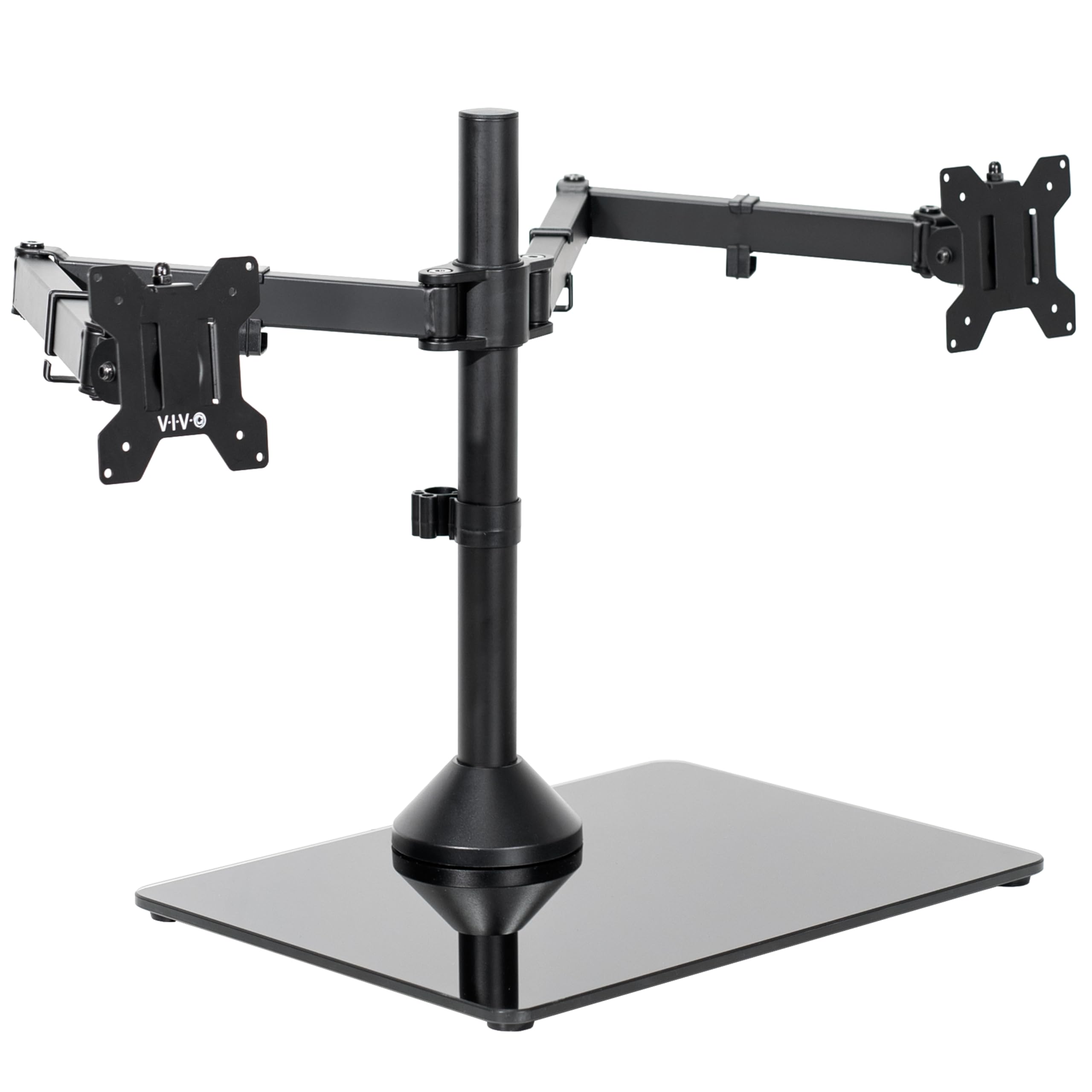
2,000+ ratings
Read Amazon ReviewsVIVO Dual Ultrawide Monitor Desk Mount, STAND-V038FG
The reviewed stand is a more compact-base option for screens within its 34-inch limit.
Consider the 38-inch model if your monitors are larger than 34 inches and fit its weight and VESA limits, while accounting for its larger base.
- This freestanding model supports two ultrawide monitors from 13 to 38 inches, up to 22 pounds each.
- It has a 17-by-12.8-inch tempered-glass base and adjustable brackets with tilt, swivel, rotation, and pole-height adjustment.
- The reviewed stand supports two ultrawides up to 34 inches and 22 pounds each, and its freestanding base measures 15.4 by 12.4 inches.
Is VIVO Dual Stand Worth It?
The VIVO Dual Monitor Desk Stand is worth considering if you want a freestanding mount for two ultrawide monitors arranged vertically. It combines a generous screen-size range, 22-pound-per-screen capacity, useful bracket adjustments, and a padded base.
Before buying, verify both monitors’ VESA pattern and weight, and measure the 15.4-by-12.4-inch base area.
Its value depends on whether a stacked layout suits your work and whether the upper screen can sit comfortably within your usual viewing setup.
Your review at a glance
3,000+ ratings
Read Amazon ReviewsVIVO Dual Monitor Desk Stand
A good fit for buyers who want two VESA-compatible ultrawide monitors stacked vertically without clamping a mount to the desk.
- Holds two monitors, each 13 to 34 inches and up to 22 pounds.
- Fits monitors with 75-by-75 mm or 100-by-100 mm VESA mounting holes.
- Freestanding base measures 15.4 by 12.4 inches and has padding underneath to help protect the desk surface.
- Adjustable brackets provide +45° to -45° tilt, 180° swivel, and 360° rotation.